From Miami to the Moon — how 22 artworks ended up at the lunar south pole
A Museum for Eternity
In 2015, Nova Spivack co-founded the Arch Mission Foundation with a mandate that read like science fiction: to create redundant backups of human civilization and scatter them across the solar system. The premise was sobering — that Earth alone was not a safe enough vault for everything humanity had learned, created, and imagined.
The first proof of concept came on February 6, 2018, when Elon Musk launched a Tesla Roadster into heliocentric orbit aboard SpaceX's Falcon Heavy. Hidden inside was a quartz disc etched at the nanoscale with Isaac Asimov's Foundation trilogy — the first object in the Arch Mission's plan to seed the solar system with human knowledge.
But Spivack understood that preserving text and data captured only one dimension of civilization. Culture lived in the brushstroke, the chord progression, the way light fell across a canvas. To truly back up humanity, you had to back up what it meant to be human — and that meant art.
From Archive to Museum
Galactic Legacy Labs, founded by Spivack alongside Lori Taylor, Lanette Phillips, and Chris Habachy, secured payload space on Intuitive Machines' upcoming lunar mission under NASA's Commercial Lunar Payload Services (CLPS) program. In 2023, a curatorial team was assembled to transform the payload from a data vault into something far grander.
A library preserves information. A museum curates meaning. The Lunaprise would become not just the first museum on the Moon, but the most permanent museum ever constructed — a collection curated for an audience that might not arrive for centuries.
The resulting collection was staggering: 222 art projects spanning 30,000 years of human creative expression, from Paleolithic cave imagery to born-digital blockchain art. The estimated real-world value exceeded seven billion dollars.
222
Art Projects
30,000
Years of Art
77,000+
Artifacts
18
NanoFiche Discs
The BitBasel Connection
One of the most distinctive threads in the Lunaprise emerged from Wynwood, Miami's epicenter of street art and creative insurgency. In 2020, Scarlett Arana and Scott Spiegel founded BitBasel, a platform dedicated to empowering artists through education, technology, and blockchain innovation.
BitBasel's CryptoArt For Impact Challenge called on digital artists to create works addressing the United Nations Sustainable Development Goals. Twenty-two artists were selected — works of striking originality that married technical sophistication with social conscience.
When the opportunity arose to include these works in the Lunaprise, the alignment was immediate. The CryptoArt For Impact winners represented exactly the kind of creative frontier the museum sought to document: art born from technologies that did not exist a generation earlier, addressing challenges that would define the generations to come.
Launch Day
Black Tie at the Cape
The evening of February 14, 2024, at the Kennedy Space Center Visitor Complex, several hundred guests gathered in formal attire for a black-tie gala unlike any the storied spaceport had hosted before. This was not a celebration of rockets or astronauts. This was a party for art — art that was about to leave the planet.
Kevin Harrington, the original Shark Tank investor. Malik Yusef, seven-time Grammy Award-winning songwriter. Scott Page, saxophonist and guitarist with Pink Floyd. Michael P. Nash, Sundance Film Festival-winning director. Prince Lorenzo de'Medici, direct descendant of the dynasty that bankrolled the Renaissance. Artists from nineteen countries. All gathered at Launch Complex 39A — the same pad from which Apollo 11 departed for the first Moon landing in 1969.
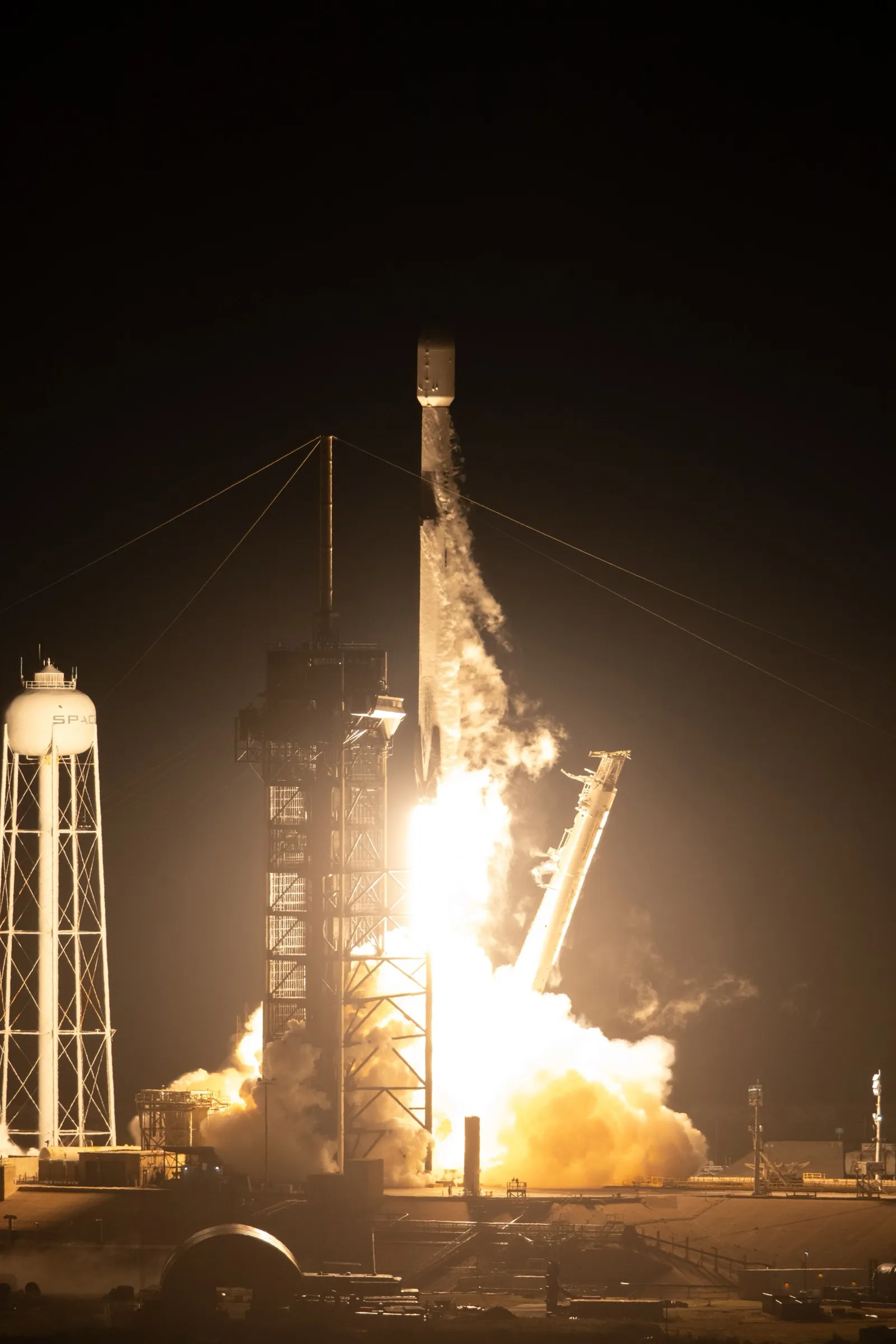
Falcon 9 on Launch Complex 39A · Kennedy Space Center · The same pad as Apollo 11
1:05 AM
At 1:05 AM on February 15, 2024, nine Merlin engines producing 1.7 million pounds of thrust turned night into noon across the Cape. The Falcon 9 climbed on its pillar of flame, punching through thin coastal clouds, bending eastward over the Atlantic.
Inside the payload fairing rode Odysseus — the Nova-C lunar lander built by Intuitive Machines, fourteen feet tall, bristling with instruments. Bolted to its exterior: eighteen metallic nanofiche discs. The Lunaprise.
This was the IM-1 mission — the first American attempt to land on the Moon since Apollo 17 lifted off from Taurus-Littrow in December 1972. Fifty-two years. In that span, the internet had been invented, smartphones colonized every pocket, and the entire genre of digital art was born. Now America was going back — and bringing a museum.
Landing
Malapert A
For seven days, Odysseus drifted through the void between worlds. The Lunaprise, bolted to the exterior, required no monitoring. It had no electronics, no moving parts, no software. It was already doing its job simply by existing.
On February 22, 2024, Odysseus began its descent toward Malapert A, a crater at the Moon's south pole — one of the most scientifically coveted destinations on the lunar surface. At 6:23 PM Eastern, Odysseus touched down. The landing wasn't perfect: a last-minute rangefinder issue forced an improvised navigation solution, and the lander came to rest at roughly 30 degrees from vertical, a foot caught on the crater rim.
For the lander's cameras and instruments, the sideways posture was a complication. For the Lunaprise, it was irrelevant. The eighteen nanofiche discs needed no particular orientation, no power, no thermal regulation. Upright or sideways, the museum was open.
Odysseus transmitted images and data for several days before the long lunar night descended and its solar panels went silent. Its final transmission included a haunting, sideways image of the lunar surface stretching toward a black horizon.
NASA and Intuitive Machines jointly declared the IM-1 mission a success. And on the surface of the Moon, near the south pole, a museum now stood — the first art collection to exist on any world other than Earth.
The silence that followed was not an ending. It was the beginning of the Lunaprise's true mission: to remain, undisturbed and enduring, while the centuries passed overhead.
2015
Arch Mission Founded
Nova Spivack co-founds the Arch Mission Foundation to create redundant backups of human civilization across the solar system.
Feb 2018
Solar Library
A quartz disc carrying Asimov's Foundation trilogy is launched into heliocentric orbit aboard SpaceX's Falcon Heavy.
Dec 2020
BitBasel Founded
Scarlett Arana and Scott Spiegel launch BitBasel in Miami's Wynwood district.
2022
CryptoArt for Impact
BitBasel's challenge selects 22 artists creating work aligned with the UN Sustainable Development Goals.
Feb 14, 2024
Launch Gala
Black-tie event at Kennedy Space Center with artists from 19 countries.
Feb 15, 2024
Launch
SpaceX Falcon 9 lifts off from Pad 39A at 1:05 AM EST carrying the Odysseus lander and the Lunaprise.
Feb 22, 2024
Moon Landing
Odysseus touches down at Malapert A crater, 80.13°S. First American Moon landing since Apollo 17 in 1972.